Exhibition / Digital archaeology
The Internet Used to Have Rooms
Before everything became a feed, there were places to go.
Register entry
Curator’s Note
There was a time when visiting the internet felt less like opening an app and more like finding a door.
Behind it might be a personal homepage with an aggressively patterned background. A fan site maintained by someone who cared far too much about a very specific thing. A guestbook. A page of links leading to other pages of links. An animated image announcing that a corner of the internet was still under construction.
The internet was never entirely free, innocent, or welcoming. But its smaller spaces often carried evidence of the people who made them.
You could tell when someone had chosen the colors. You could tell when they had learned one new trick and immediately used it everywhere. You could tell when they had lost interest and left everything exactly where it was.
Today, much of our online life takes place in spaces designed for us rather than by us. We move through timelines, recommendations, uniform profiles, and interfaces that have already decided where our attention should go next.
The strange little rooms have not entirely disappeared.
They have simply become harder to stumble into.
This exhibition preserves six things about an internet that once made more room for wandering.
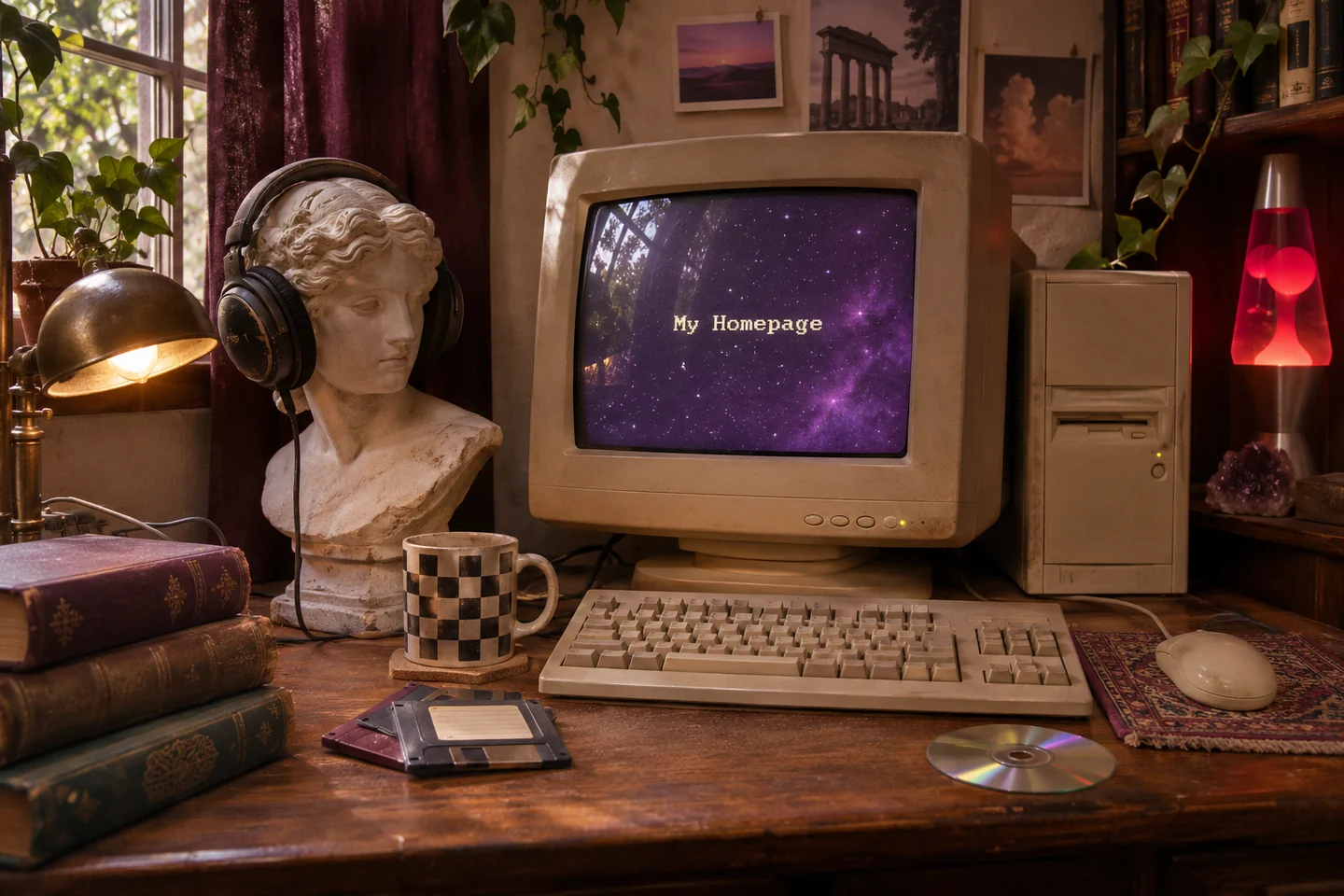
Object 001: The Personal Homepage
Classification: Digital Self-Portrait
Status: Increasingly Unusual
Before the polished personal brand came the personal homepage.
A place to announce your interests, display your favorite things, share questionable design decisions, and provide information absolutely nobody had requested.
It did not necessarily explain what you could offer the world.
Sometimes it just explained that you liked frogs.
Museum observation: Not every online identity was originally a professional opportunity.
Object 002: The Guestbook
Classification: Social Furniture
Status: Largely Abandoned
A visitor could leave a message simply to establish that they had been there.
No follower count was required. No algorithm needed to distribute the interaction.
Someone might write, “Cool site.”
That was the entire exchange.
It was enough.
Museum observation: There was once a small pleasure in being witnessed without being measured.
Object 003: The Page of Links
Classification: Human-Made Navigation
Status: Still Operational in Select Locations
Someone found something interesting and added it to a list.
You clicked one link, followed another, and arrived somewhere that had nothing to do with your original intentions.
There was no guarantee the destination would be useful.
That was part of the arrangement.
Museum observation: Discovery and recommendation are not quite the same experience.
Object 004: The Under Construction Sign
Classification: Public Admission of Incompletion
Status: Endangered Attitude
A tiny animated construction worker informed visitors that the website was not finished.
Nobody needed to pretend otherwise.
The site existed anyway.
Pages could be unfinished, awkward, experimental, and available to the public before their creators knew what they were becoming.
Museum observation: We have grown unusually uncomfortable with visible works in progress.
Object 005: The Visitor Counter
Classification: Primitive Attention Instrument
Status: Historically Significant
A small row of numbers at the bottom of a page announced how many visits the site had received.
Perhaps you were visitor 0000437.
For a moment, your arrival was part of the architecture.
The number was displayed openly, sometimes proudly, sometimes for no discernible reason.
Museum observation: Even the smaller web counted its visitors. It simply had less sophisticated ways of making the counting everyone’s problem.
Object 006: The Abandoned Room
Classification: Digital Ruin
Status: Last Updated: Unknown
Somewhere, there may still be a homepage whose owner stopped updating it years ago.
The links may be broken. The images may be missing. The last entry may promise an update that never arrived.
Nobody officially closed the room.
It was simply left behind.
Museum observation: An abandoned website can preserve something a constantly updated feed cannot: the particular moment when someone stopped speaking.
Exit Note
The point is not that the old internet was better in every way.
It was often inaccessible, unreliable, exclusionary, slow, and remarkably ugly.
But its odd little spaces remind us that an online presence does not have to be a performance, a storefront, a content strategy, or a machine for collecting attention.
Sometimes it can just be a room someone made.
You are now leaving the exhibition.
If you find a strange little website on your way out, consider staying awhile.