Reading Room 002
Things We Are All Doing Because an App Suggested It
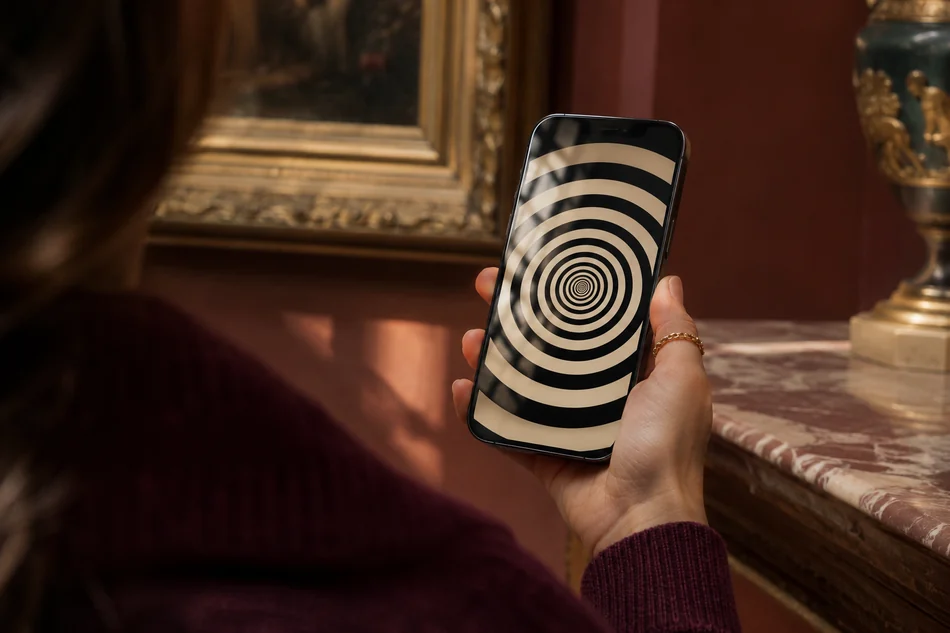
Register entry
- Classification
- Modern Behavior / Artificial Culture
- Collection
- The Reading Room
- Estimated reading time
- 4 minutes
An informal investigation into the increasingly crowded space between personal preference and automated suggestion.
There is something fascinating about having a preference you cannot remember developing.
A song you suddenly enjoy.
A product you now consider essential.
A restaurant you have never visited but feel strangely familiar with.
A particular shade of green that apparently belongs on every kitchen cabinet.
At some point, you saw it on a screen.
Then you saw it again.
And again.
Eventually, it stopped feeling like something being recommended.
It started feeling like something you liked.
The Suggestion Arrives
Modern applications are exceptionally good at offering possibilities.
A video platform recommends what to watch.
A shopping application suggests what to purchase.
A music service creates a playlist based on what you have listened to before.
A social platform decides which strangers deserve your attention.
A navigation application proposes the fastest route through a neighborhood you barely recognize.
None of these functions is inherently sinister.
Recommendations can be extraordinarily useful.
They help us discover music, ideas, businesses, artists, and information we might otherwise never encounter.
The interesting question is what happens when suggestion becomes the dominant way we experience choice.
An Entirely Reasonable Purchase
Consider the hypothetical journey of a decorative lamp.
You do not need a lamp.
You have not been thinking about lamps.
You have never expressed an interest in lamps.
But one afternoon, a lamp appears in a beautifully arranged room on your screen.
It is a strange lamp.
Possibly shaped like a mushroom.
You keep scrolling.
Two days later, you see another mushroom lamp.
This one is described as sculptural.
Soon, you begin noticing mushroom lamps everywhere.
A week later, you are comparing prices.
By the following weekend, you have developed a surprisingly sophisticated opinion about mushroom lamp proportions.
You may still decide not to buy one.
But something remarkable has happened.
An object you previously ignored has become a category of personal interest.
The lamp has entered your consciousness.
Without knocking.
The Appearance of Consensus
Repeated exposure can create another peculiar effect.
When a particular aesthetic, phrase, product, or behavior appears frequently in the spaces we visit, it can begin to feel culturally inevitable.
Suddenly, everybody seems to want the same style of apartment.
The same water bottle.
The same breakfast.
The same oddly specific type of chair.
Of course, everybody does not want these things.
But our individual feeds can create the impression that certain preferences are much more universal than they actually are.
A recommendation system does not necessarily show us a representative sample of humanity.
It shows us selected material.
Yet it can become surprisingly easy to mistake that selection for the world itself.
The Taste Question
This does not mean our preferences are artificial.
Taste has always been influenced by culture.
Friends recommend books. Families pass down recipes. Communities establish aesthetic traditions. Advertisements introduce desires. Artists influence other artists.
Human beings have never developed preferences in isolation.
What feels different about contemporary digital recommendation systems is their scale, speed, personalization, and persistence.
The suggestion can follow us across an ordinary afternoon.
And because these systems respond to our behavior, the relationship becomes circular.
We show interest in something.
The system presents more of it.
Our interest grows or changes.
The system responds again.
Eventually, the boundary between what we independently sought and what we were repeatedly shown becomes difficult to identify.
Perhaps there was never a completely clean boundary.
But it used to be easier to recognize the person recommending the mushroom lamp.
An Artificial Opinion
The modern internet has created an extraordinary abundance of choice.
It has also developed increasingly sophisticated methods for arranging those choices before we encounter them.
That distinction deserves more attention.
Because sometimes we are making decisions.
Sometimes we are responding to suggestions.
And sometimes we are doing both so seamlessly that the difference no longer occurs to us.
Meanwhile, somewhere in a warehouse, another mushroom lamp is being prepared for shipment.
It has absolutely no idea what it started.
Museum Observation: Your taste may be entirely your own. The introduction was probably arranged.